
These exercises can be completed one after the next in a ‘mobility routine’. They can help your range of motion in the low back and between the shoulder blades as well as in some cases, relieve back pain. If you are struggling with kneeling, please find the lying down version on our website.
Watch the video below to see how to properly perform kneeling lower back mobility exercises and follow along at home.


Instructions
Part 1 – Cat-camel
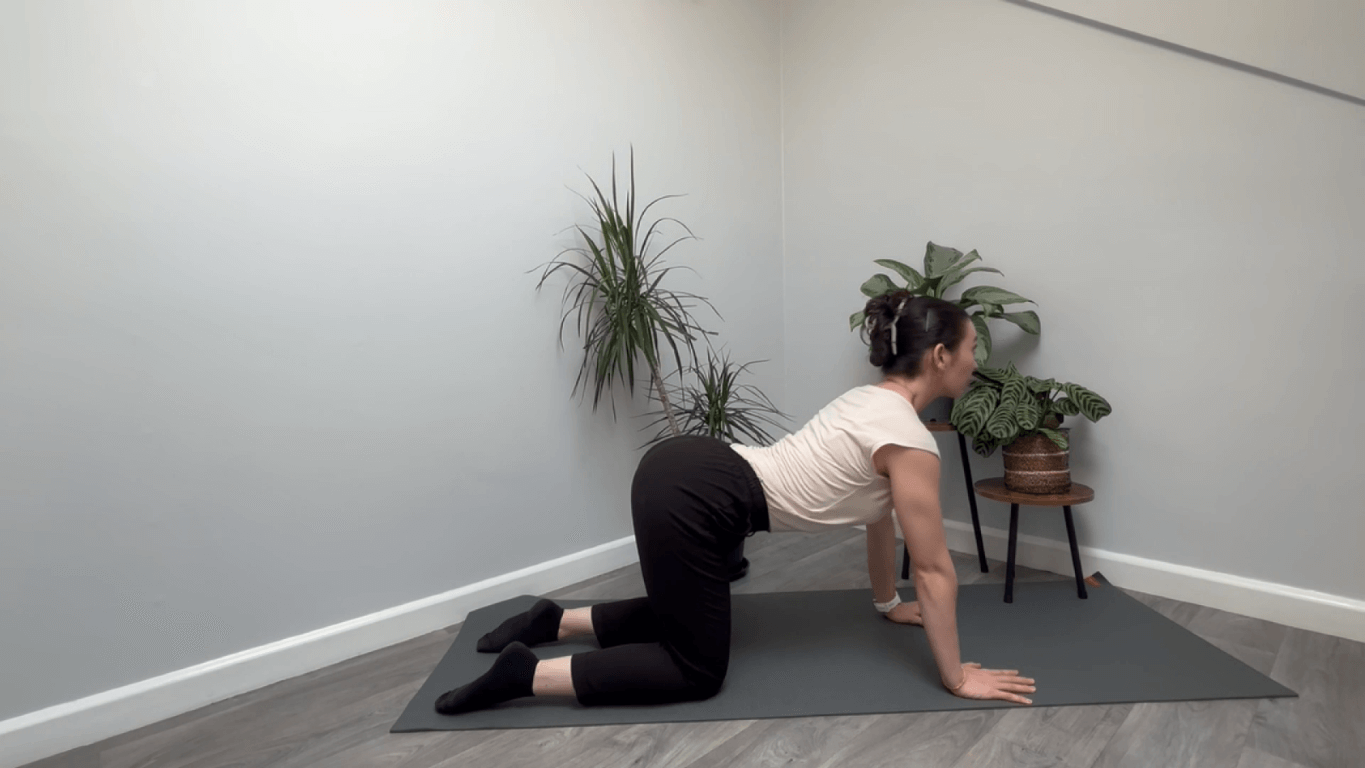
- To start, get into a ‘tabletop position’ by kneeling on all fours on a comfortable surface. Align your hands directly under your shoulders and your knees under your hips. Keep your neck in a neutral position, looking down at the floor.
- Lightly tighten your abdominal muscles to support your spine. You can do this by pulling your belly button towards your spine or imagine bracing yourself to expect a strong punch to the stomach.
- Exhale and slowly round your back by arching your back upwards, tucking your pelvis under and drawing your belly button toward your spine. Tuck your chin toward your chest, creating a C-shaped curve in your spine.
- Briefly hold this position before inhaling and arching your back the other way by gently lowering your belly toward the floor as you tilt your pelvis upward. Lift your head and chest, gazing slightly upward while creating an opposite curve in your spine.
- Flow between the Cat and Camel poses, moving slowly and in sync with your breath. Your clinician will advise how long to hold each position for as well as how many sets and repetitions to do.
Part 2 – Thread the Needle
- Start on your hands and knees, with your hands under your shoulders and knees under your hips.
- Take one hand off the floor and reach in between your other arm and your legs.
- Allow your body and head to follow, moving your shoulder down towards the floor as your hand reaches through. You should feel a stretch down your side, shoulder blade and neck.
- Briefly hold this position, and then return to the starting position.
- If you would like an additional stretch/challenge, continue to reach your arm out to the other side, up towards the ceiling and opening up the chest. Follow the movement of your hand with your head, twisting in the other direction to look up towards the ceiling but without straining the neck.
- Briefly hold this position before returning to neutral then repeating the sequence. Remember to do this on both sides.
- Your clinician will advise how long to hold each position for as well as how many sets and repetitions to do.
Part 3 – Child’s Pose
- Start on your hands and knees, with your hands under your shoulders and knees under your hips.
- Stretch your hands forwards, dropping your head between your shoulders to rest on the floor or supported by a cushion. At the same time, sit your buttocks back onto your heels. You can have your knees together or slightly apart depending on your comfort.
- Breathe deeply and steadily, relaxing into the pose with each exhale. You will feel this stretch through your back and upper arms.
- Return to the tabletop hands and knees position to finish before standing slowly.
- Your clinician will advise how long to hold each position for as well as how many sets and repetitions to do.
Common Mistakes and Top Tips
- Do not rush – Take it slowly and gently, remembering to breathe.
- Try not to overarch the back in the cat-camel exercise in either direction to the point where you feel discomfort, keep it within a comfortable range.
- Do not overreach the arm during the thread the needle. Again, it is about keeping everything within a comfortable range.
- In the child’s pose, you may need to adjust how close together your knees and feet are from each other so that it feels comfortable. You can place cushions, towels or a yoga mat underneath you for comfort too if you wish.