



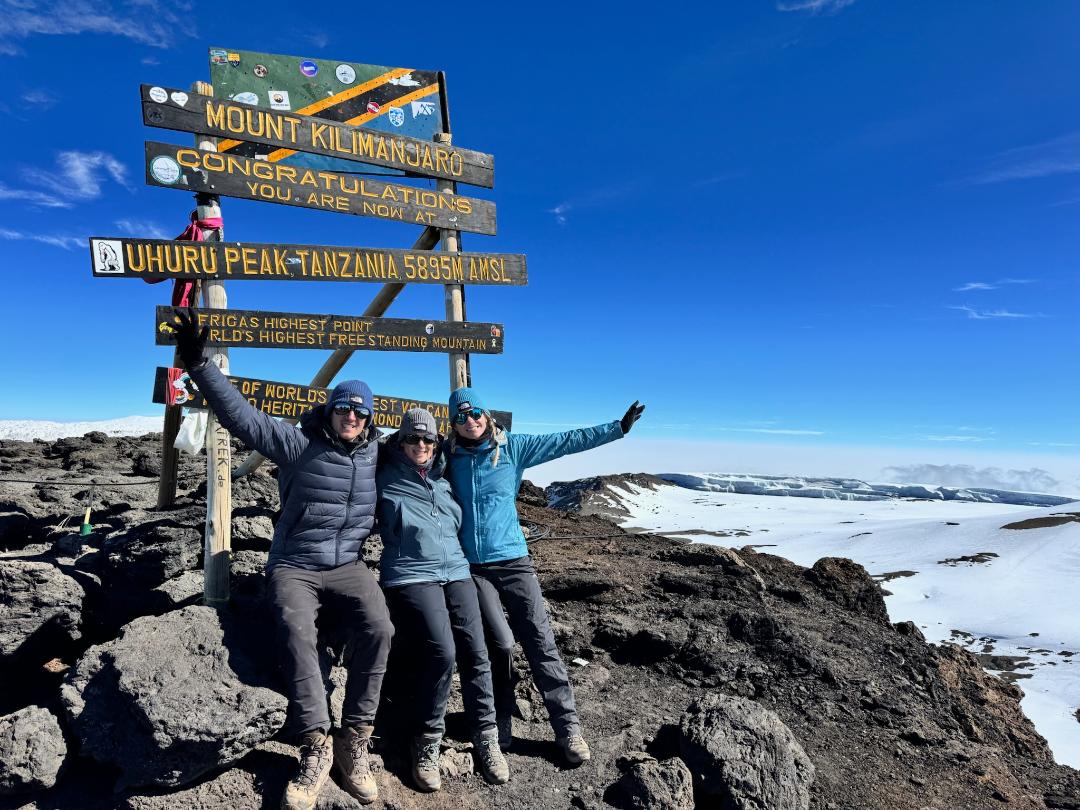
Climbing Kilimanjaro has been on my bucket list for years. However, at age 63, I did wonder if I had left it too late. My children, Steph and Chris, who are in their early 30’s, had already climbed Kilimanjaro two years earlier. In January 2025, we decided that we would all go, and a trip to Tanzania with a company called G Adventures was booked for late June/ early July,
Kilimanjaro is 5895m high. It doesn’t require any technical climbing skills, but it only has a success rate of around 65%, with altitude sickness being one of the main problems. The air at the summit contains about half of normal levels of breathable oxygen at sea level. The temperature can also vary by 500C (from 350 C at the bottom to -150C at the top). We booked the longer Lemosho route, which takes 8 days, but gives the best chance of avoiding altitude sickness, as there is more time to acclimatise. The climb involves hiking up to 10Km per day on the way up. The pace is very slow, which also helps with acclimatisation. The exception is summit night, where the total distance up and down is 17km. It sounds relatively easy, but the altitude, steepness, and rocky terrain, make it so much harder than it appears on paper.
After booking, I spent much of the next six months focussed on preparations. I already had a basic level of fitness, as I belong to a Stroud based ladies fitness group, called Gfit.life. I also enjoy walking, although I cannot say I love hills, and I had virtually no mountain climbing experience. For improving fitness, I concentrated on three areas:
- Increasing my exercise classes with Gfit.life to 4-5 hours per week, particularly for leg and core strength (using some weights), and cardio fitness.
- Running – I followed the Couch to 5 k programme. At the start, I could barely run a minute, and I gradually increased this to 25 minutes.
- Hill walking – 2-3 walks per week, carrying weight, including as many ascents and descents as possible. The majority of my walks were around 8-10 miles, but I did a handful involving 15-17 miles. The Cotswold Way was very useful, and I actually stopped hating Gruntas Lane and Pound of Candles, coming out of Harescombe! A month before we left, the three of us also attempted the 3 Peaks National 24 hour challenge as part of our preparation. We went with an organised group, who provided guides and the transport between Ben Nevis, Scafell and Snowdon. This is a total contrast to Kilimanjaro, as it required speed. Out of a group of 9, only 4 made the challenge (including Steph and Chris), with 10 minutes to spare. One girl’s knees gave out and the remaining 4 (which included me), were considered too slow. I climbed a 1000m out of 1345m of Ben Nevis, before being turned back, so as not to hold up the chances of the faster ones making the challenge. Despite this frustration, it was still very useful to experience the rocky terrain of the mountains, which is so different to the relative comforts of the Cotswold Way. It was also a chance to try out some of the equipment for Kilimanjaro, such as a head torch.
Keeping myself injury free during training was important, particularly as I have a history of random back problems. Anna Hawrot, from Spinavita chiropractic clinic in Quedgeley, kept my back in order, with increased maintenance sessions in the run up to the trip. Anna was incredibly supportive, and gave me some great all-round advice. It is interesting to note that the more exercise I did, the less apparent historical issues became.
Shopping for all the clothing and equipment for Kilimanjaro seemed a never- ending task, as a lot of my kit needed an upgrade. Even the postman commented that I seemed to be doing a lot of shopping! Some of my best purchases included:
- A new backpack- which I had properly fitted using the Cotswold Outdoor fitting service.
- Walking poles – I could not have managed without them.
- Heat pads – for hands and feet on summit night
- SPF lip balm
At the end of June, I found myself at the bottom of a very large mountain, feeling slightly terrified. There were just 4 people in our group, the three Pikes and an experienced hiker from California. Supporting the 4 of us were no less than 18 people from G Adventures. This may sound unbelievable, but everything has to be taken up the mountain, including camping and cooking equipment, plus food for our meals, as well as an (optional) group loo for camp nights. Trust me, the loo was worth the extra money! Most of the crew were porters, plus three catering staff and two guides. The porters are incredible, and so strong. They carried our main luggage, so we just carried our day backpacks, which had to include 3 litres of water. All the crew were really lovely people, and could not do enough for us. Our two guides helped me immensely, carrying my coats/ water at various times, and in the later stages they also carried my entire backpack. They just wanted us all to succeed.
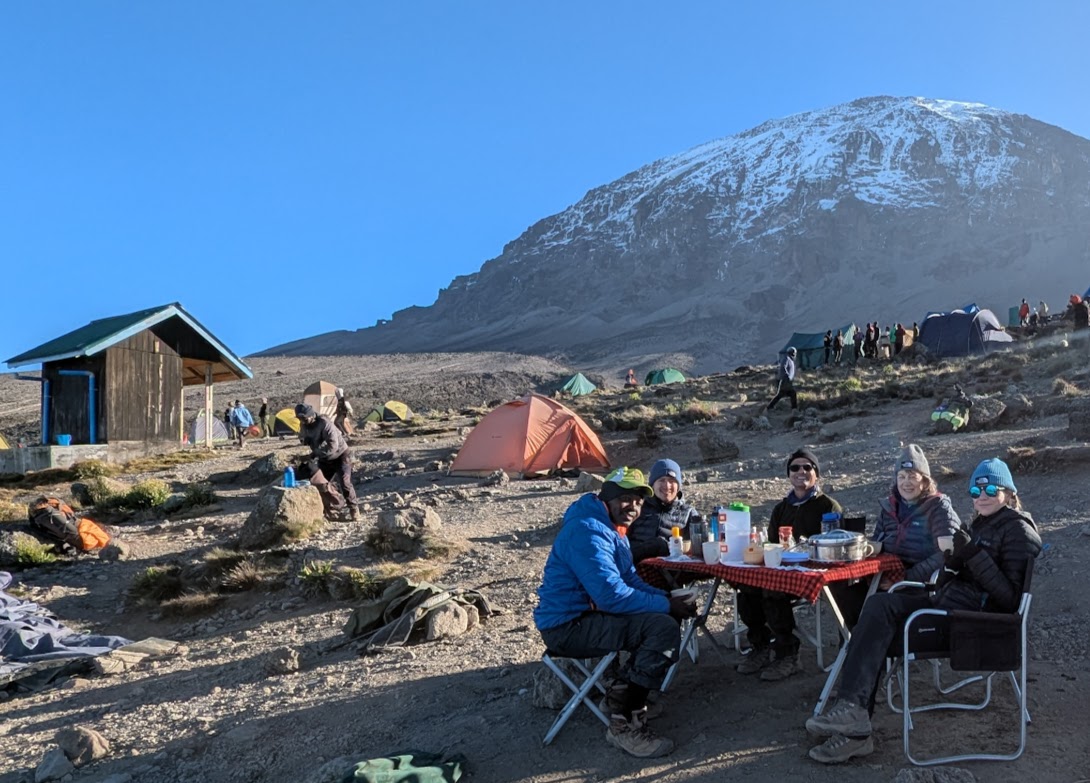
It took from the Sunday to Friday night for us to reach the base camp. Over those six days we passed through the rain forest, moorland, and alpine desert zones, saving the artic zone for summit night. Each day we did between 4 and 10 km and camped in shared tents at night. On a couple of days, we climbed higher than our intended destination, and then came down slightly, to sleep at a lower level. This was all to help with acclimatisation. Each morning, we would leave for the day’s hike with our guides, but before the porters. The porters would then dismantle our camp, pack up, pass us at speed along the way, and then set up the next camp before we arrived. Breakfast, lunch and dinner were all cooked at the camps.
My favourite day was climbing the Barranco Wall. At first this looks like a sheer rockface, but there is a way to scramble up. It becomes quite crowded, as you have to wait for people from other groups, and porters, to negotiate the tricky bits. I saw one poor chap who was frozen with fear. As I hate heights, I am not sure why I enjoyed it, but I did take care not to look down.
One of the hardest things for me was drinking enough water, as the recommendation is to drink 4.5 litres a day to reduce the chances of altitude sickness. Our oxygen levels and heart rates were checked by the guides every morning and evening. All four of us had good oxygen levels throughout. We were also asked to highlight specific symptoms that might be a sign of altitude sickness, such as headaches, loss of appetite etc. All of this was documented. As a group, we all faired pretty well, except for some very minor headaches. My biggest problem was lack of sleep, as I struggled to sleep well in the strange environment. I also found it difficult to eat enough. The food quantities were generous, and there was nothing wrong with it, but it just wasn’t my type of food. I don’t think it was the altitude, it was just me.
By the time the Friday came, I was quite fatigued, due to lack of sleep and food. We did a 4 km walk in the morning. Then we had to prepare and rest for summit night. We were woken at 11 pm, before leaving at 12am. Summit night involves climbing 1200 m of rocky and steep terrain, mostly in the dark, with the use of a head torch, in freezing conditions. It is hard! As well as the guides, a handful of porters were chosen to summit with us, the rest of them staff remaining at base camp. Again, the G Adventures staff helped me so much, carrying my backpack and giving me a hand with the high rocky step ups. We had some great views as the sun started to rise, although I could do little except focus on just putting one foot in front the other.
By 8 am we had completed the steepest section and reached Stellar Point, at 5756m. It is then just a matter of hiking along the edge of the crater for about 1km to the highest point, called Uhuru Peak. This last bit seemed to take forever, with icy snow underfoot, and I had to keep stopping, through sheer exhaustion. However, with the encouragement of the guides and my children, all four of us had made it by around 9.30 am. The views at the top, way above the clouds, were stunning. However, we were only allowed to stay for about 15 minutes, due to the risk of altitude sickness.
After the euphoria of reaching the summit, going down again is hard. A lot of the descent route is shifting scree, and it is very easy to fall. As ever, the guides and porters were happy to assist. One guide and one porter linked arms with me, and helped me down (or was it dragged ?!). Doing it in reverse makes you realise the steepness and length of the ascent on that final night. On reaching base camp, we were given some much-needed lunch. We then had to dig deep and to do another 7 km of rocky descent that afternoon. The next day we had a final hike of 10 km, this time on a muddy, slippery path, back through the rain forest, to the end. Finally, we arrived back at our hotel for a long-awaited shower. We then stayed for a further week in Tanzania to do a safari in the Serenegeti.
In conclusion, it was an amazing trip, despite being considerably outside my comfort zone at times. G Adventures went above and beyond, and the Tanzanian people are all so lovely. For anyone who likes a challenge, climbing Kilimanjaro is well worth the effort.
Get in touch with Spinavita Chiropractic


Call
Explore more
 ArticlesMore about Growing Pains: What’s Normal and When Should You Be Concerned?
Growing Pains: What’s Normal and When Should You Be Concerned?
By Anna Hawrot
 ArticlesMore about End of exams? Time to check in with your spine
End of exams? Time to check in with your spine
By Anna Hawrot
 ArticlesMore about Ultra-Processed Foods (UPFs)
Ultra-Processed Foods (UPFs)
 ArticlesMore about Exercise through the ages
Exercise through the ages
By Jennifer Barr
Sign-up for updates
Join our community! Sign up for exclusive updates, wellness tips, and special offers delivered straight to your inbox.